Edition 2.0 · May 2026
Don't be that parent.
A brutally honest, illustrated field manual for parents whose children play mini rugby in Hong Kong. Thirteen sections. Fifteen archetypes. One simple rule.

A note from the editor
If you bought boots last weekend and your kid runs out for their first mini rugby session this Sunday, this guide is for you. If you have been doing this for nine years and think you've heard it all, this guide is also for you — particularly section 7. We have all been one of those parents at some point. The first step is recognition.
— The editor
Section 01
What mini rugby actually is
Mini rugby is the form of the game played by children from age 4 to 12 in Hong Kong, before youth rugby begins at U13. It is a graduated, age-appropriate version of the sport. The contact level scales up gradually with the players.
The format at every age grade is set by World Rugby and adapted by the Hong Kong Mini Rugby Football Union (HKMRFU). The headlines:
Source: RFU Age Grade Codes of Practice, Regulation 15, and the HKFC U5–U8 Coaching Manual.
The rules at every age grade are different. The thing that's a penalty at U10 isn't even a thing at U7. So when you find yourself shouting at your U7 about "knock-ons," see Section 7.
The goal of mini rugby is not to win matches. It is to keep children playing the sport long enough that some of them go on to play youth, schools, club, and — for a small handful — international rugby. Every metric that matters at this age is a retention metric. A team that wins every U8 match but loses half its players by U10 has failed. A team that loses every U8 match but keeps 90% of its players to U12 has succeeded. Most parents have this backwards.
Section 02
The HK rugby ecosystem in one page
Hong Kong rugby is a small ecosystem in which everything is connected. Five layers feed each other.
- The Union — HKCR. Hong Kong China Rugby is the national governing body. It runs the senior leagues (Premiership, A-Division), the representative pathway, the development programmes, and is the body that contests 2027 Rugby World Cup qualification.
- The clubs. 19 of them run active mini sections, listed in section 4. These are where your child actually plays. Each club has its own culture, training day, fees, and waiting list situation.
- The competitions. HKMRFU runs the mini rugby festival circuit. Hysan Youth runs U13–U18. Schools have their own circuit. The HK Sevens hosts a youth tournament that sits inside the senior festival.
- The festivals. The annual mini rugby festival at HKFC. The Christmas tournaments. The Waterford Bowl. The Kim Lam Cup. The HK Sevens youth weekend. These are the cultural anchor points of the season.
- The national teams and the showcase. The HK Men's 15s qualified for the 2027 Rugby World Cup. The HK Women's team plays in WXV and will host the WXV Global Series Challenger 2026 at Kai Tak from 13–26 September 2026, against Brazil, Fiji, Netherlands, Samoa and Spain. The HK Sevens, of course, sits at the cultural centre of the whole thing.
The key insight: all five layers feed each other. The HKCR development officer who runs your kid's Sunday clinic is the same person who picks the U16 squad. The volunteer coach at your club is also a referee at the schools tournament. Hong Kong rugby works because the pipe is short and everyone knows everyone.
It also fails for the same reason. A small ecosystem has fewer second chances. Which makes the volunteer-and-contribution question — section 9 — not optional.
Section 03
The HK mini rugby calendar
Mini rugby in Hong Kong runs from September to April. Here is what the season looks like, month by month.
Three dates to put in your calendar
The HKFC Youth 10s — 11–12 April 2026. A rebrand of HKFC's long-running Youth International Cup, sitting in the lead-up to the 50th anniversary HK Sevens. U5–U7 play a single-day festival on Sunday 12 April; U8–U18 run a two-day competitive format. HKFC Youth 10s.
The Waterford Bowl — late January. Organised by HKMRFU at HKU Stanley Ho Sports Centre, Pok Fu Lam. "The pinnacle of U11 rugby in Hong Kong" (DB Pirates). Bowl, Shield and Plate divisions.
For girls, the Kim Lam Cup is the marquee — see section 8.
Section 04
The mini rugby clubs of Hong Kong
The HKCR Mini and Youth Rugby Clubs directory lists 19 active mini clubs running U6–U12 sections. For a parent choosing where to sign up on a Sunday morning, those 19 are the live options.
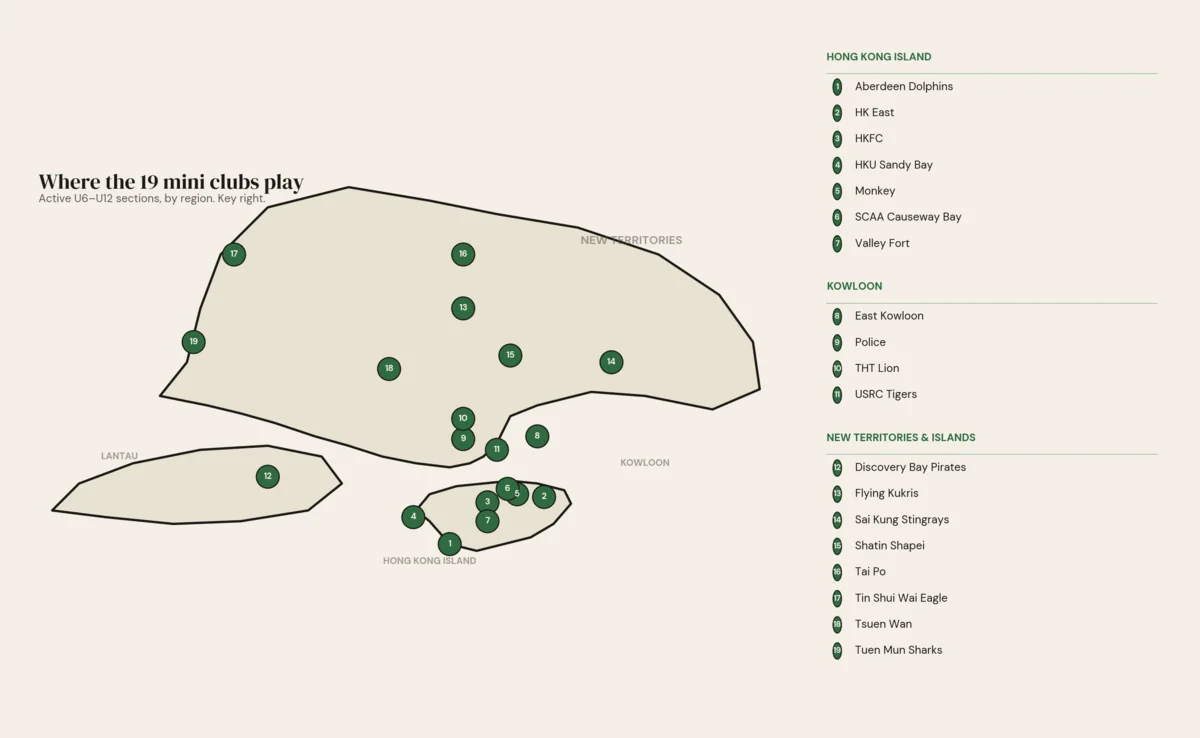
Hong Kong Island
- Aberdeen Dolphins RFC
- Hong Kong East RFC
- Hong Kong Football Club
- HKU Sandy Bay RFC
- Monkey Rugby Club
- SCAA Causeway Bay RFC
- Valley Fort RFC
Kowloon
- East Kowloon RFC
- Police RFC
- THT Lion Rugby
- USRC Tigers RFC
New Territories & Outlying Islands
- Discovery Bay Pirates RFC
- Flying Kukris RFC
- Sai Kung Stingrays RC
- Shatin Shapei RFC
- Tai Po RFC
- Tin Shui Wai Eagle RC
- Tsuen Wan RFC
- Tuen Mun Sharks RC
If a venue or detail has changed, or if you believe a club is missing or no longer active, write to us at editor@thetryline.com. Corrections will be carried in the next edition.
Choosing a club is mostly logistics — where do you live, what day works, can your kid get there reliably for an eight-month season. The culture differences exist but are easy to over-read. Visit two before committing. Most clubs welcome a trial session.
Section 05
What it actually costs (and how a club stays alive)
Mini rugby in Hong Kong is the cheapest organised youth sport you will find that is run to a credible standard. That sentence is true and it is not an accident. It is held together by a fragile economic model and a lot of unpaid hours.
What you pay
A full mini rugby season runs roughly September to April — about 30 Sunday mornings, plus festivals, training kit, a club shirt, and end-of-season presentation. The fee for all of that, at most clubs:
Most clubs cluster between HK$1,650 and HK$2,500 for the season. HKFC is the high-end outlier because it is a private members club running a much larger rugby section.
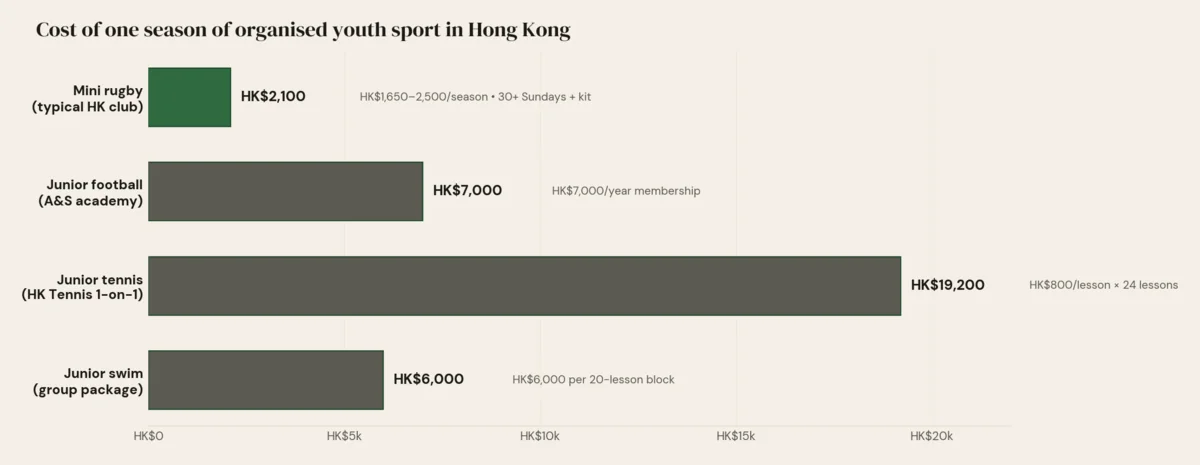
Junior football academies charge around HK$7,000/year (A&S Football); a 20-lesson group swim block runs HK$3,000–6,000 (Toby); one-on-one junior tennis at HK$800 a lesson hits HK$19,200 over 24 lessons (HK-Tennis). Mini rugby is the cheapest credible team-sport option in the city by a meaningful margin.
How a mini club stays alive
No mini rugby club survives on membership fees alone. The model is roughly five income streams stacked together — and five categories of expense the money flows out into.
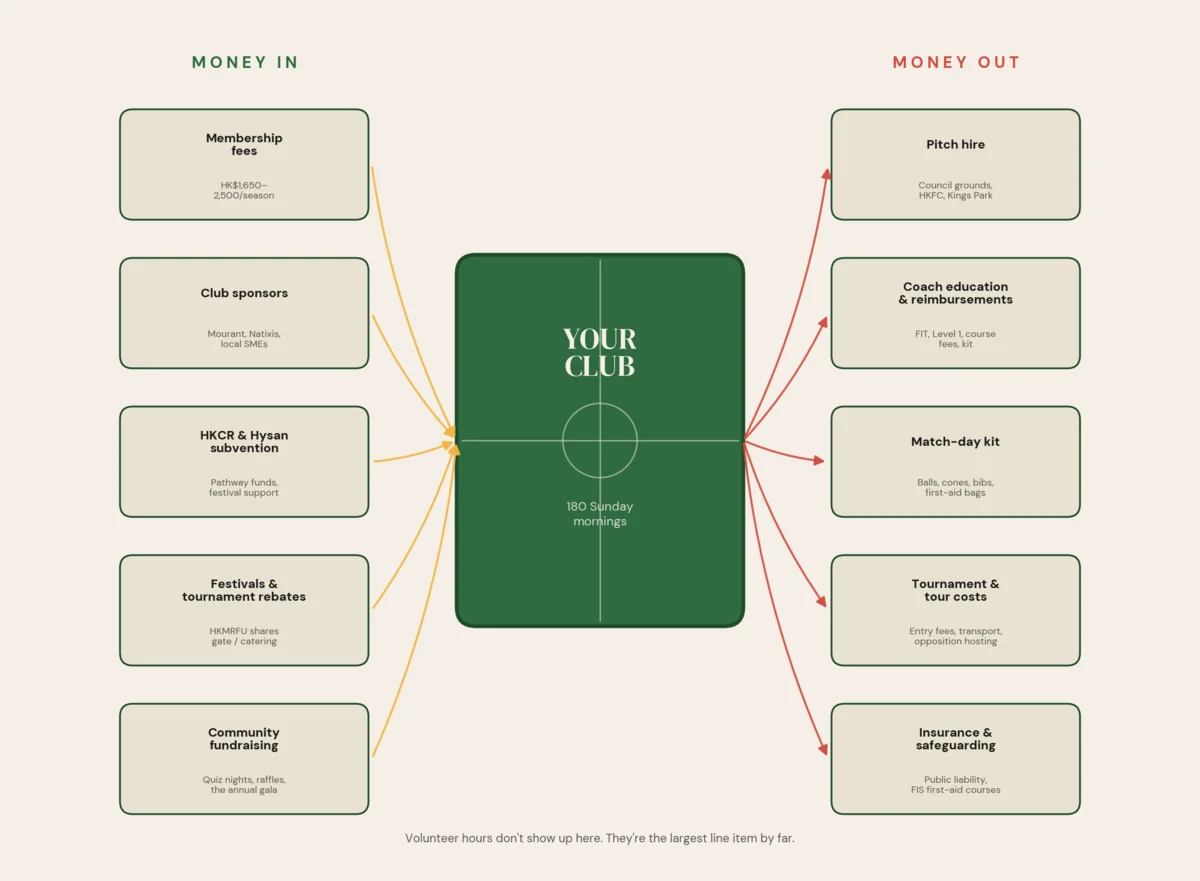
In 2021 the union cut junior funding by roughly 50% in a cash crisis, and clubs had to find the difference themselves — through harder fundraising or trimmed programmes (SCMP). Several clubs never fully recovered. Today the pathway is partly underwritten by the Hysan x HKCR partnership, and individual clubs lean on long-running corporate sponsors — Mourant and Natixis sit behind HKFC's rugby section, for example.
The number that does not appear on any of these lists is volunteer hours. If you priced those at market rates, every club in the territory would be technically insolvent. They are why the fees can stay where they are.
Which is, again, the entire point of section 9.
Section 06
Your first session: what actually happens
You arrive ten minutes early. You are still late.
Your child is wearing the wrong shorts. Everyone else's child also wore the wrong shorts on their first day, which you do not yet know. There is a parent in a high-vis vest who appears to be in charge of registration; they will become the most important person in your weekend life for the next decade. Their name is on the WhatsApp group, which you have not yet been added to.
What to bring
- Boots (rubber studs only — no metal, ever)
- Mouthguard (mandatory from U7 — boil-and-bites at the club shop)
- Gum shield case
- Two water bottles. Always two.
- Sunscreen, hat, change of clothes
- Cash for the canteen (HK$50 covers most situations)
What to expect
- 10–20 minutes of organised chaos before training starts
- A coach who knows your kid's name by week three
- A queue for the toilet you do not want to be in
- A clubhouse afterwards that is the secret point of the whole thing
The unwritten rules
- Do not coach your child from the touchline. (See section 7.)
- Do not approach the head coach to discuss your child's positional development. They are managing 30 seven-year-olds in 28-degree humidity. It is not the moment.
- Introduce yourself to two other parents. Ask if they're new too. Most will be.
- Stay for a drink afterwards. The clubhouse is where you'll learn 90% of what you need to know.
Section 07
Don't be that parent
Every weekend, somewhere in Hong Kong, a child is playing mini rugby badly because their parent is on the touchline doing one of the following.
You are probably one of these. We have all been one of these. The first step is recognition.
 01
01The Touchline Coach
Has Strong Opinions. Shouts tactics at U7s mid-run.
 02
02The Rulebook
Confidently misidentifies a knock-on as a forward pass. Loudly.
 03
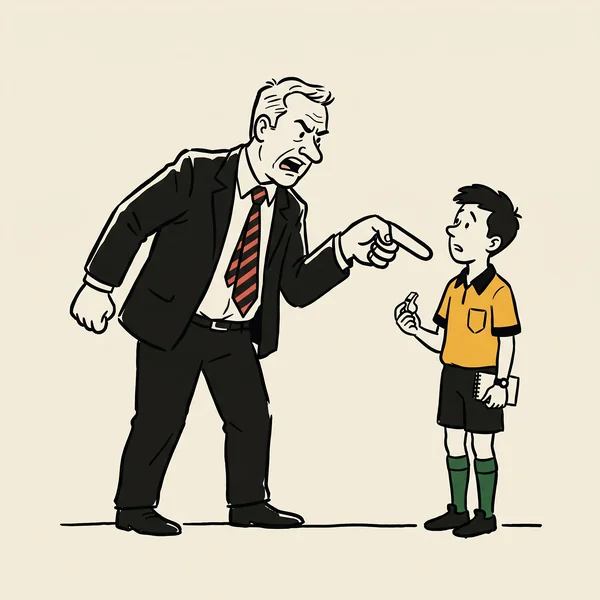
03The Ref Critic
The ref is fifteen and volunteering. You're a corporate lawyer.
 04
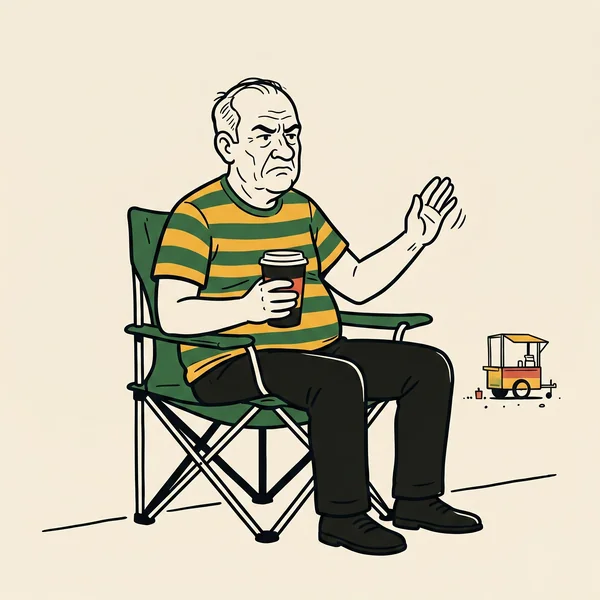
04The Armchair Critic
Why is there no coffee truck? Never volunteers.
 05
05The Late Replier
Four messages in. Three read. The deposit is overdue.
 06
06The Repeat Asker
What time is training? Every. Single. Week.
 07
07The Match Tourist
Drops off, drives away, returns at the whistle. Misses everything.
 08
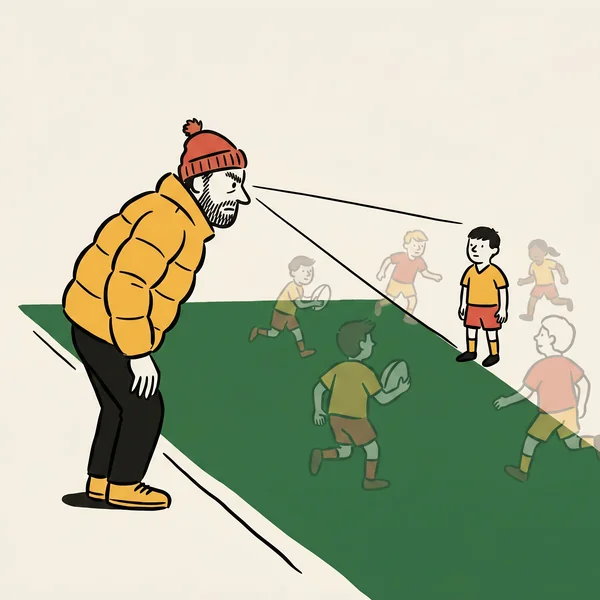
08The Tunnel Visionist
Watches their own child only. Doesn't know any other kid's name.
 09
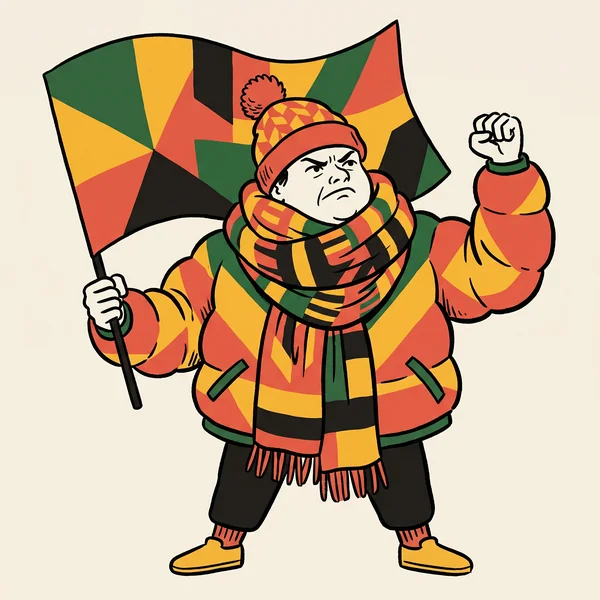
09The Tribalist
Hates the opposition. They are seven.
 10
10The Phone Holder
Films every minute. Watches none of them.
 11
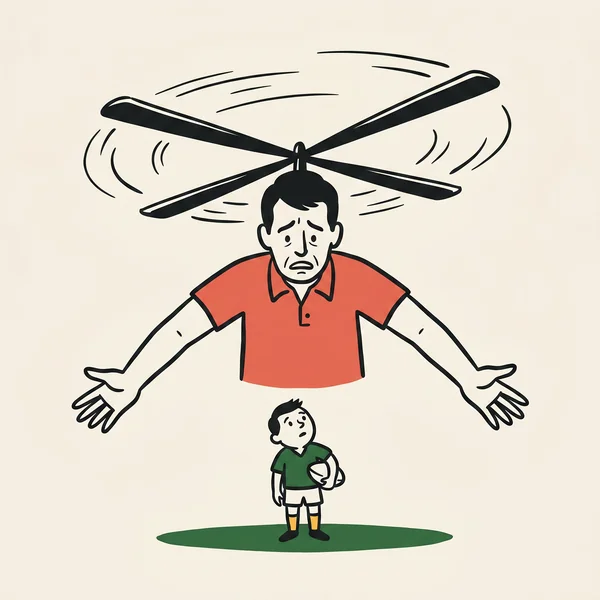
11The Helicopter
On the pitch, unbidden, for water, sunscreen, a hug.
 12
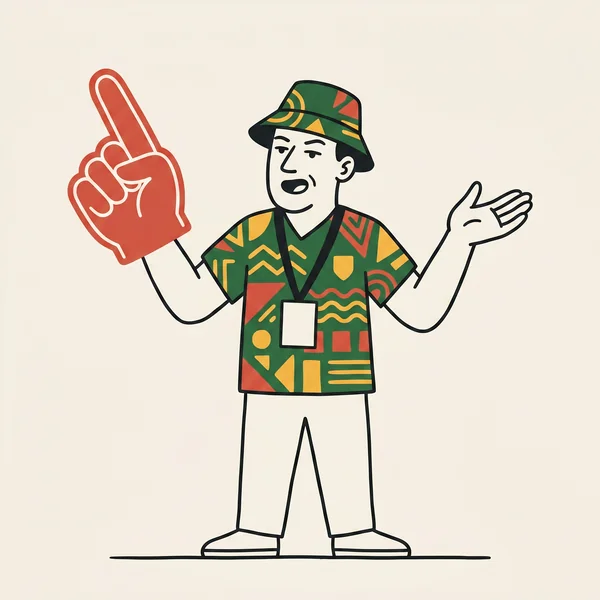
12The Sudden Expert
Played touch in 1998. Now lectures the head coach.
 13
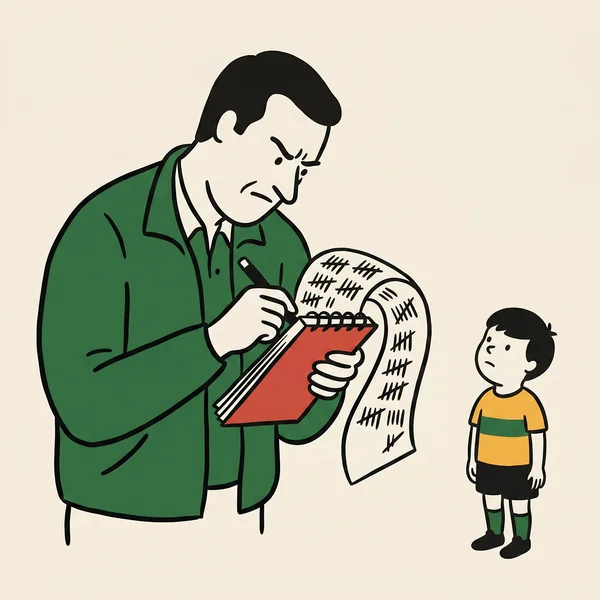
13The Scoreboard
Asks the U7 final score. There is no U7 final score.
 14
14The Seasonal Disappearer
Vanishes for the festival. Returns for trophy day.
 15
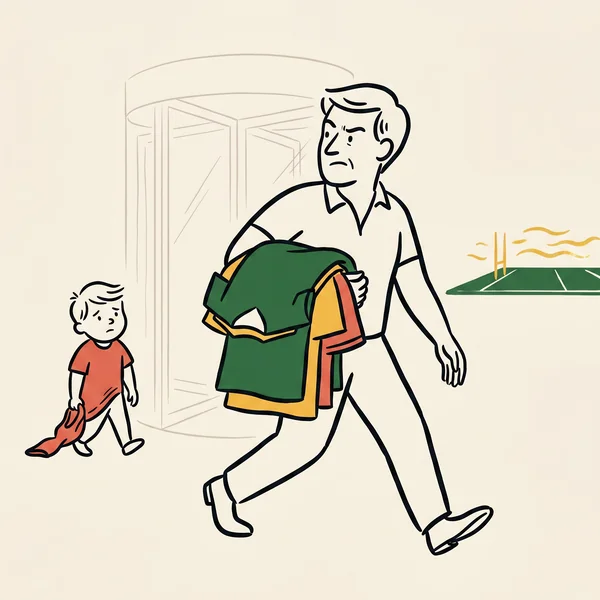
15The Club Hopper
Three clubs in two seasons. Searching for the perfect one.
If you saw yourself in more than one, welcome. Most of us are at least three of these on a bad weekend. The next section is the cure.
Section 08
The girls' game in Hong Kong
For too long, girls' rugby in Hong Kong was a footnote in a guide aimed at parents of boys. It is no longer.
Hong Kong's women's pathway is now one of the most visible in Asia. The HK Women's team plays in Almaty at the Asia Rugby Emirates Women's Championship from 28 April–9 May 2026, then hosts the WXV Global Series Challenger at Kai Tak from 13–26 September 2026 — five matches against Brazil, Fiji, Netherlands, Samoa and Spain on home soil. Your daughter will, for the first time, be able to watch a Hong Kong women's team play a global series at the national stadium. That matters.
The competitions and what they signal
The Kim Lam Cup — U12 girls. Held at HKFC, named after Kim Lam, a driving force in HKCR women's rugby since 1998. "The first serious competition of junior youth rugby that under-12 girls will play in Hong Kong" (HKFC Rugby). It is the ceiling-raiser for an entire age group.
The Cathay Youth Invitational 7s — U12 to U18, boys and girls, played at the Kai Tak Youth Sports Ground. The Sevens-format tournament that runs alongside the senior festival.
Hysan Youth Girls fixtures from U13 — see section 12 for the full pathway.
What to do if you have a daughter starting
Sign up like any other player. Ask the club about girls-only sessions. Get her to a women's HK match — there are now real ones to take her to. The pathway is no longer hypothetical.
Section 09
How to actually help — eight ways to contribute
Here is the part nobody tells you when you sign your child up.
Mini rugby in Hong Kong runs on volunteers. Every coach holding a clipboard, every team manager sending the WhatsApps, every first aider with the cold pack, every referee blowing the whistle on a Sunday morning is a parent who decided to do more than drop off and watch.
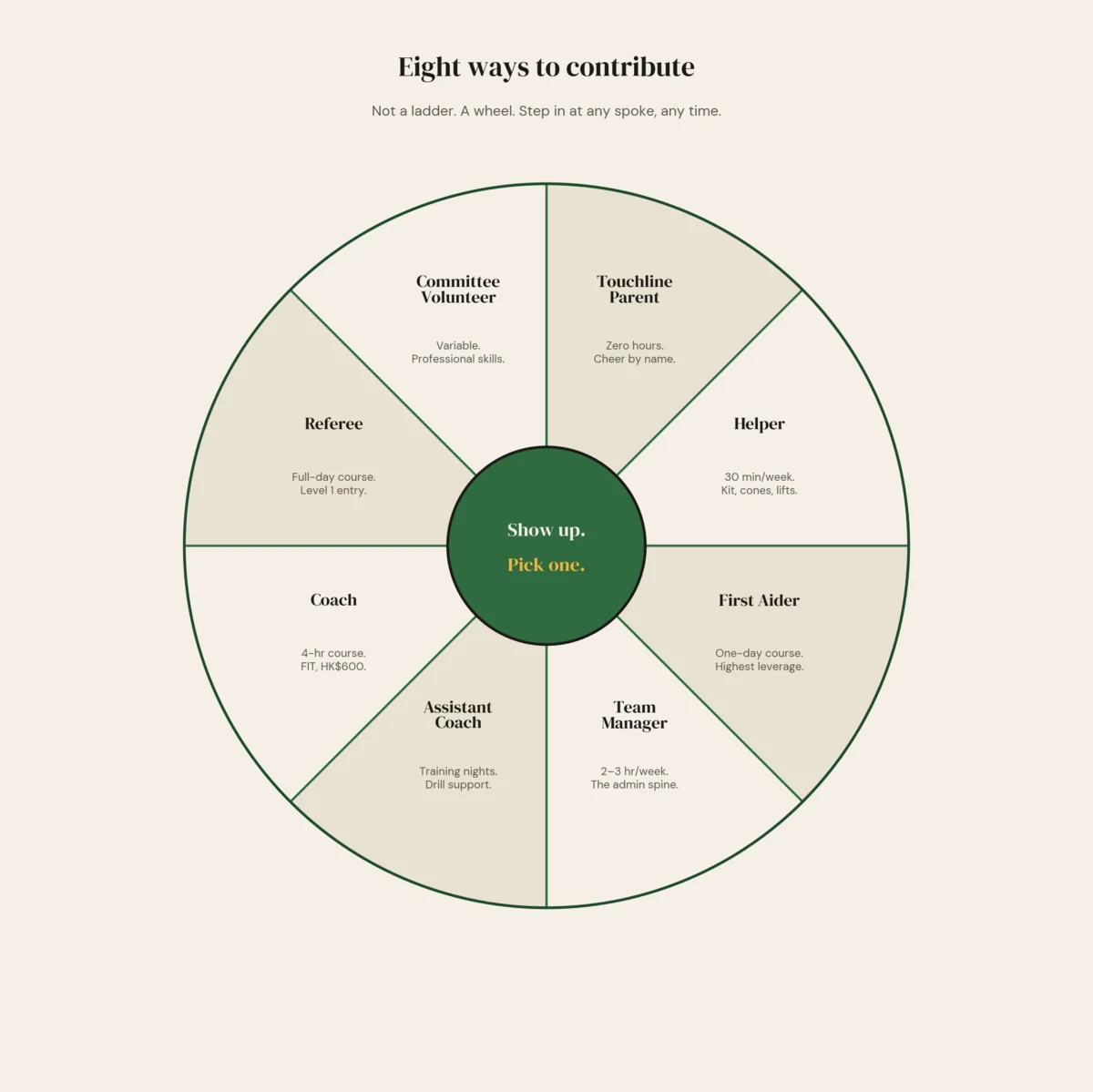
The Helper
30 mins/week. Set up cones. Hand out water. Go home. Costs you nothing. Saves the coach 30 minutes.
The First Aider
One day course (FIS or equivalent) + matchday availability. The job that means contact rugby is safe rugby.
The Team Manager
The WhatsApp captain. The one who knows who is and isn't coming. If you are organised, this is your job.
The Coach
World Rugby Coaching Foundation course (free, online). Then turn up every Sunday for a season.
The Referee
Volunteer match official course at HKMRFU. The hardest, most thankless job. The most respected.
The Treasurer
If you are a finance person and you have ever sat in the clubhouse thinking I could do this better — yes, you could. They need you.
The Section Head
The strategic role. Five-year vision, coaching standards, club culture. Senior commitment.
The Club Trustee
Long-term governance. Where the previous seven roles eventually flow if you stay.
The rule of thumb every Hong Kong rugby club lives by: for every player on the pitch, you need roughly half a parent doing something useful off it. A team of 20 minis needs 10 active contributors to run well. Your team has 20 minis. Count the contributors. If the maths doesn't work, that's where you come in.
Section 10
Pitchside behaviour and rugby etiquette
Rugby has a reputation for being well-behaved on the touchline. This reputation is mostly accurate, but it is not accidental — it's maintained, weekend by weekend, by parents who model the etiquette and gently call out parents who don't.
What to do
- Cheer for everyone — your team, the opposition, the ref
- Stand behind the dead-ball line, not on the pitch
- Clap the opposition off at the end. Always.
- Help with set-up and pack-down without being asked
- Stay for the third half (the post-match social)
What not to do
- Coach from the sideline
- Shout at, or about, the referee — particularly if they are 14
- Disparage opposition players, parents, or coaches
- Bring grievances to the WhatsApp group
- Confront a coach pitchside about your child's playing time
The third half
The post-match social. The thing rugby has and most other sports don't. Take it seriously. Stay for it. This is where the next decade of friendships, coaching opportunities, lift-shares, tour roommates, and sponsor introductions happens. It is also where your child sees that the people they were just hitting are also the people they are now sitting next to. That lesson is more valuable than anything they will learn in the match itself.
Section 11
Safety, player welfare, and what good coaching looks like
Rugby is a contact sport. Mini rugby is a contact sport that has been carefully designed to be safer than most things your child will ever do — but it is not risk-free, and the parent's job is to know what good safety looks like so you can tell when it isn't there.
The global safety framework
World Rugby's Player Welfare programme sets the standards for age-appropriate contact, mandatory protective equipment, concussion protocol, and coach training. Every HKCR-affiliated club operates under these standards.
The Hong Kong specifics: mouthguards mandatory from U7. Coaches must hold World Rugby Coaching Foundation certification at minimum. First aiders on every pitch. HKMRFU enforces the contact-progression schedule (the table in section 1).
What good coaching looks like
- Warm-up done properly. Not a token jog. Dynamic stretching, age-appropriate handling drills, pulse raised.
- Tackle technique taught before tackle is allowed. Body position, head placement, leg drive — practised on bags before practised on bodies.
- Equal-ish playing time. Not "the best six play the whole festival." Every kid gets minutes.
- Concussion protocol followed visibly. Any head knock, the player comes off. No exceptions.
- Coach hydrates the team and themselves. The HK heat is real.
If your club's coaching consistently doesn't meet this bar, raise it with the section head, privately, with specifics. Do not raise it in the WhatsApp group. Do not raise it on the touchline. Do not raise it on Facebook.
Section 12
Pathways beyond minis
Mini rugby ends at U12. From U13, the world expands.
Youth club rugby — Hysan Youth. HKCR's youth competition is the Hysan Youth league, running from U13 to U18. Both 15s and 7s formats are played.
Schools rugby — HKSSF. The Hong Kong Schools Sports Federation runs an extensive schools rugby competition — primary and secondary. Many of the top Hong Kong rugby pathways flow through schools more than clubs. HKSSF.
Representative rugby — HKCR Talent Pathway. HKCR runs a representative pathway from U16 upwards, with development squads and age-grade national teams. Talent ID happens at festivals and regional trials.
National teams. The HK Men's 15s qualified for the 2027 Rugby World Cup. The HK Women's team plays in WXV. The pathway is real.
Two things to hold in mind. First, most kids who play mini rugby will not play youth rugby. That is fine. Mini rugby was a gift in itself — the friendships, the fitness, the toughness, the rugby values. The pathway is not the point. The participation is.
Second, the representative pathway is not the only pathway worth caring about. A child who becomes the team manager of their U16 side is being trained for a life of leadership. A child who becomes a referee at 16 is being trained for a life of fairness. The game produces more than players, and the parent who sees this is the parent who has understood it.
Section 13
Glossary, FAQ, and final word
Quick glossary
- Try (5 points)
- Touching the ball down past the opposition's try line.
- Knock-on
- Dropping the ball forward — penalty.
- Ruck
- The pile of bodies after a tackle, contesting the ball on the ground.
- Lineout
- Throw-in from touch — both teams contest the ball in the air.
- Scrum
- Eight forwards bind, push, contest possession. Uncontested at U11, contested at U12.
- Two-hand touch
- HK U7–U8 format — defender places two hands on the ball-carrier to "tackle".
- Third half
- The post-match social. The actual point of the whole thing.
FAQ
Q: When is registration?
A: Most clubs open registration in May–June for a September start. Popular clubs fill within a week. Get on a waiting list early.
Q: How much does it cost in total?
A: HK$1,650–2,500 for the club season at most clubs (HKFC is more — see section 5). Add ~HK$1,000 for kit, boots, mouthguard.
Q: Is rugby safe for my child?
A: Rugby is a contact sport, and contact sports carry an injury risk that non-contact sports do not. The honest answer is: there is a real, non-zero risk of concussion and other injuries — not large, but not negligible. What mini rugby does to mitigate this is the graduated structure described in section 1: two-hand touch and non-contact at U6–U8, tackle introduced gradually from U9, contested scrums only from U12. Coaches are trained to World Rugby standards. Concussion protocol is enforced. The risk is real and is managed, but it is real. The bigger risk for many kids is sedentary childhood; the question for each family is how they weight the two. We trust you to make that call with the data, not against it.
Q: Do we have to do tours?
A: No. Tours are optional and expensive (HK$3,000–8,000 per tour). They are also where some of the best memories of mini rugby happen. Each family decides. Don't let anyone shame you either way.
Q: I want to volunteer but I work long hours.
A: See section 9. The First Aider role costs you a one-day course and matchday availability. The Helper role costs you 30 minutes a week. There is a job for every level of capacity. The clubs need you.
Final word
If your child plays mini rugby in Hong Kong for six seasons, you will spend roughly 180 Sunday mornings at a pitch. (That's 30 weekends × 6 years.) That is a real chunk of life.
You can spend it as a passenger, watching from a folding chair, scrolling your phone, slightly resentful about the early start. Or you can spend it as a contributor — knowing the kids' names, knowing the coach, holding a clipboard or a flag or a first aid bag, in the clubhouse afterwards, in the WhatsApp group, in the running of the thing.
The first version is fine. The second version is the one that, in five years, you'll realise was the best part of your week.
Don't be that parent.
Be this one.
Take it with you
Download the full guide.
25 pages. Designed for print. Updated May 2026. Free for parents, coaches, and clubs.
Download the PDF (9.8MB)